Robotic Knee Replacement in Delhi

Precision Knee Surgery for Better Mobility

Severe knee pain caused by osteoarthritis, degeneration, or injury can limit movement and affect quality of life. Robotic Knee Replacement offers a highly accurate, minimally invasive solution to restore mobility, reduce pain, and ensure long-term implant success.

Dr. Atul Jaspal, a National Board Certified Joint Replacement Surgeon, is trained in robotic-assisted knee replacement, ensuring exceptional precision, customized implant positioning, and faster recovery for patients.

What Is Robotic Knee Replacement?

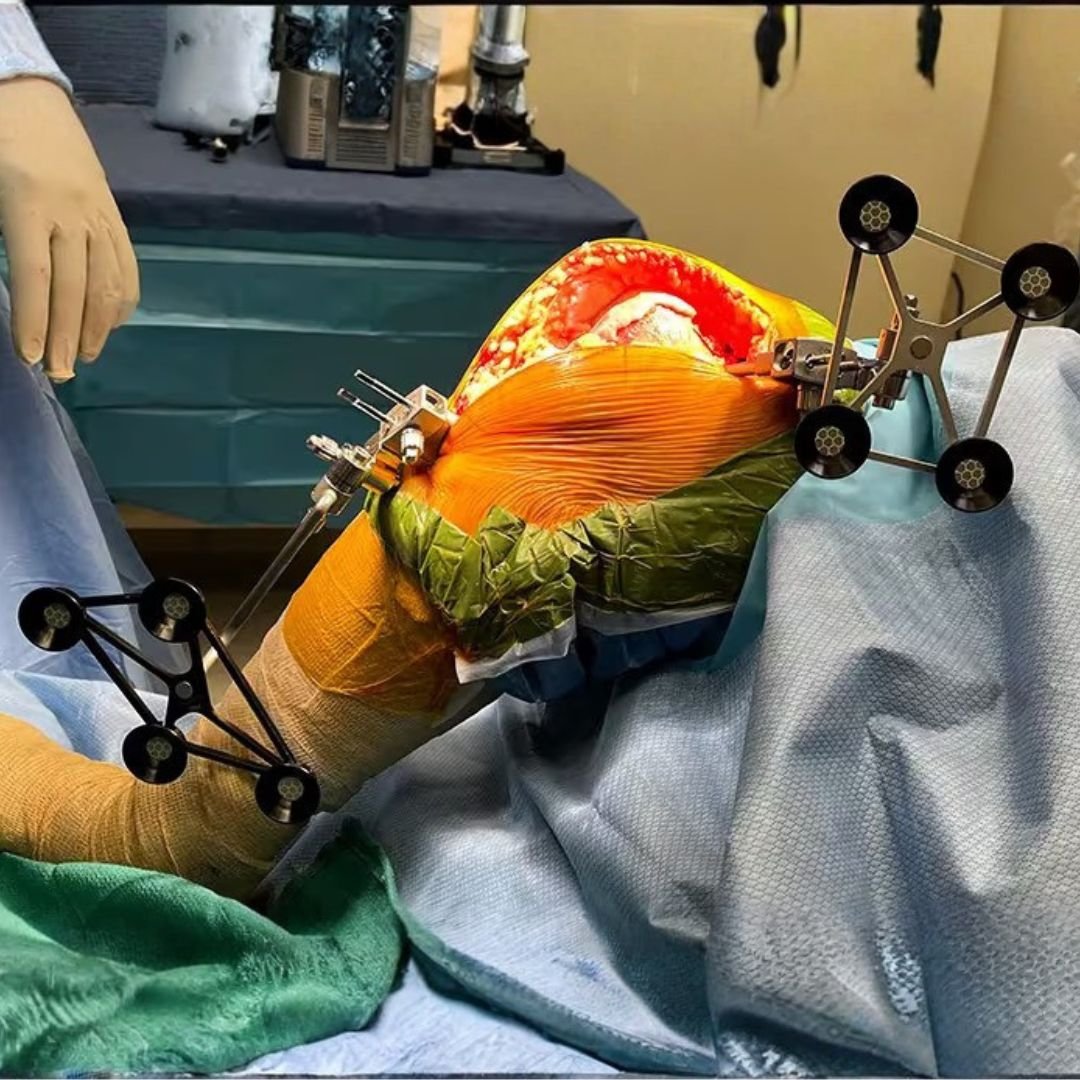
Robotic Knee Replacement is an advanced knee replacement technique in which a robotic system assists the surgeon in planning and performing the procedure with a high level of accuracy. A detailed 3D scan of the knee is used to create a personalized surgical plan, after which the robotic arm guides the surgeon in removing damaged bone and cartilage with sub-millimeter precision. The implant is then positioned exactly according to the patient’s unique anatomy, ensuring more natural knee movement, reduced pain, and long-lasting results.

Conditions & Symptoms That May Require Robotic Knee Replacement

Causes

  • Severe osteoarthritis

  • Rheumatoid arthritis

  • Post-traumatic arthritis

  • Knee deformities (varus/valgus)

  • Failed previous knee surgeries

Symptoms

  • Persistent knee pain during movement or rest

  • Stiffness and swelling limiting flexibility

  • Difficulty walking, climbing stairs, or squatting

  • Knee instability or deformity

  • Reduced quality of life despite medications or physiotherapy

Diagnosis Before Robotic Knee Replacement

Dr. Atul Jaspal performs a detailed assessment including:

  • Medical History & Physical Examination – To check pain, range of motion, and joint alignment.

  • Imaging Tests – X-rays and MRI/CT scans to understand joint damage and create a 3D model.

  • Pre-Surgical Evaluation – Assessing overall health, bone quality, and suitability for robotic surgery.

Treatment Options

Non-Surgical Management

  • Pain-relief medications

  • Physiotherapy and strengthening exercises

  • Knee braces

  • Injections (viscosupplementation or corticosteroids)

  • Lifestyle changes and weight management

These provide short-term relief but may not work in advanced arthritis.


Surgical Treatment

  • Robotic Total Knee Replacement
    Removal of damaged cartilage/bone and placement of an artificial implant with robotic precision.

  • Robotic Partial Knee Replacement
    Replacement of only the damaged knee compartment, preserving healthy bone and ligaments.

  • Minimally Invasive Techniques
    Smaller incisions, less bleeding, and quicker recovery.

  • Customized Surgical Planning
    Personalized implant positioning using advanced 3D imaging.

Robotic Knee Replacement Procedure

The procedure begins with a thorough pre-operative evaluation, including a medical check-up, imaging, and physiotherapy to prepare the joint. Depending on the patient’s suitability, spinal or general anesthesia is administered. During surgery, a 3D model of the knee guides the procedure, allowing damaged bone and cartilage to be removed with robotic precision while positioning the implant accurately to match the patient’s anatomy and preserving soft tissues as much as possible for natural movement. The incisions are then closed with minimal scarring, and early mobilization usually starts within 24 hours, with the entire procedure typically lasting 1.5 to 2.5 hours.


Post-Operative Care & Recovery

  • Hospital Stay: Usually 2–3 days

  • Initial Phase (Weeks 1–3): Pain control, wound care, walking with support

  • Rehabilitation (Weeks 3–8): Strengthening, gait training, improved mobility

  • Intermediate Phase (2–4 Months): Return to daily activities

  • Full Recovery: 3–6 months depending on individual progress

Benefits of Robotic Knee Replacement

  • Higher surgical accuracy

  • Better implant alignment and longevity

  • Smaller incisions & minimal tissue damage

  • Reduced pain and faster recovery

  • Improved knee stability and natural movement

  • Lower risk of complications

  • More predictable surgical outcomes

Get more Information

FAQs – Robotic Knee Replacement

Robotic Knee Replacement is an advanced form of knee replacement surgery where a robotic-assisted system helps the surgeon perform the procedure with enhanced accuracy, precision, and control.

Unlike conventional surgery, robotic knee replacement uses 3D digital mapping and computer-guided tools to plan and execute the surgery with greater precision and minimal tissue damage.

No. The robot does not operate independently. The surgeon is in full control at all times. The robotic system only assists in making precise bone cuts and aligning the implant accurately.

Patients with severe knee arthritis, chronic pain, deformity, or limited mobility who have not improved with medications or physiotherapy may be ideal candidates.

It offers improved implant accuracy, better alignment, reduced blood loss, smaller incisions, less pain, faster recovery, and long-lasting results.

Yes. Robotic-assisted systems are designed to enhance safety by avoiding surrounding tissues and nerves. The surgeon monitors and controls every step of the procedure.

Reach Us

Seamless Appointments for Quality Orthopaedic Care

Dr. Atul Jaspal Bone & Joint Clinic

Shanti Mukand Hospital

Expert orthopaedic care by Dr. Atul Jaspal—providing trusted, precise, and patient-focused treatment for all bone and joint problems in Sunder Vihar, Paschim Vihar, Delhi.

Follow Us on
Quick Links
Specialities
Contact Us
  • 91-96509 85398
    91-96509 85398
  • atuljaspal@gmail.com
    atuljaspal@gmail.com
  • 9/314, Ground Floor, Sunder Vihar, Paschim Vihar, Delhi-110087 (Near St. Mark's Sr. Sec. Public School and opposite Punjab & Sindh Bank)

Copyright © 2025 Dr. Atul Jaspal. All Rights Reserved. | Designed by Artistry Media

Scroll to Top